

Contents
Last updated: August 2026
Cite Article
Introduction
If you’ve landed on this article, you almost certainly have an interest in philosophy of life. But depending on where you are in your journey, your level of knowledge and understanding of the topic will vary.
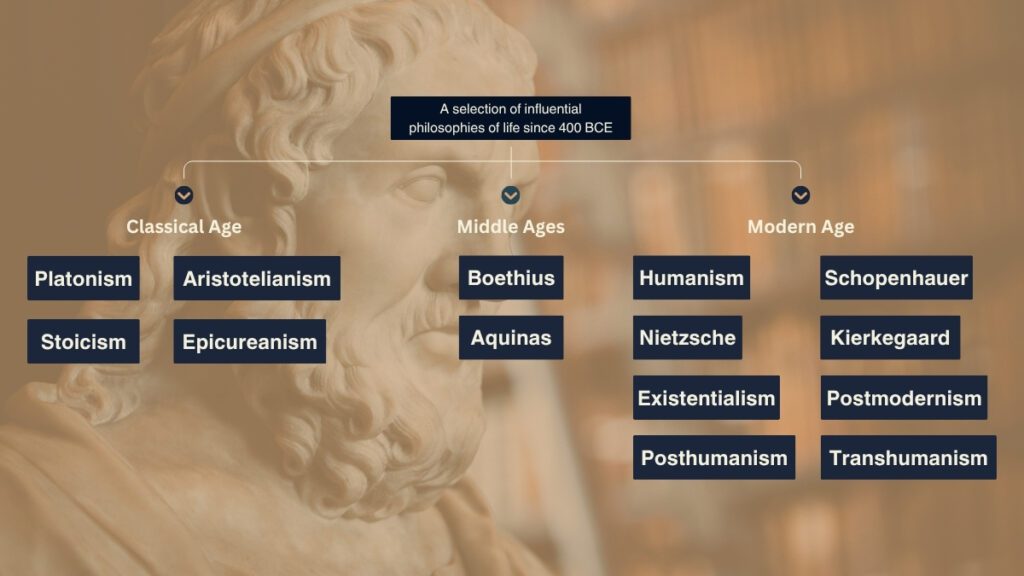
So, first, here is a general definition of what we’re talking about: a philosophy of life is a framework built out of ideas that guides the way we live. Since the Classical Age, various distinct philosophies of life have emerged in the Western philosophical tradition. Western philosophy has not only been concerned with philosophy of life – it has also weighed in on highly theoretical matters that are more removed from daily life. It has provided frameworks for how we should think of science, how we should answer highly abstract theological questions, and how we should frame psychological research into the functioning of the mind.
Subscribe to the FREE Philosophy of Life Newsletter
Explore the Philosophy of Life Newsletter 🧠 One philosophy article. Broken down into 3 ideas, 3 reasons it matters, and 3 questions to sit with — every week. That's the Philosophy of Life Newsletter. Join 2,000+ readers making philosophy useful again. 👉 Subscribe Today .
While these are interesting uses of philosophy, they are not the uses that this article is about. You may have already started to look into philosophies of life like Stoicism and existentialism. But how much do you know about the background worldviews that gave rise to these approaches? My premise in writing this article is: every philosophy of life emerges from a broader worldview.
Philosophies do not exist in a void. It can be very misleading to simply “transplant” a philosophy of life created in the past to the present day. For example, in considering Stoicism, it is essential to reflect on how much of the underlying Stoic worldview you are willing to accept, given what we know about the universe and today’s human realities. The same is true of all of the influential philosophies of life from the past.
These points are not emphasized nearly as often as it should be by today’s leading advocates and proponents of various philosophies of life. That is why the first section of the article is dedicated to charting out different philosophies of life and succinctly describing the worldview that operates in the background. Since we’re on the topic of worldviews, how should we think of the world today and into the future?
Obviously, this isn’t Greece, 300BCE or 400 BCE, the period in which Stoicism, Aristotelianism, and the other great philosophies of the Classical age came into being. In the third section, I describe what I have been calling “algomodernism” and outline features of a philosophy of life that is fit for the future.
Common Elements of a Philosophy of Life
A philosophy of life typically incorporates three key components:
- Metaphysics – This explores the nature of reality. It asks big questions like “Why does the universe exist?” or “What is the nature of being?” Metaphysics helps shape our understanding of what is real and how the world works.
- Ethics – Ethics focuses on what is right and wrong, guiding our actions and decisions. It involves considering how we treat others, how we balance personal needs with those of the community, and what makes a “good” life. (See Ethical Theories)
- Meaning and Purpose – This component reflects on why life matters and what goals or values give it significance. It’s about identifying what makes life fulfilling, whether it’s relationships, achievements, or contributing to a greater good. (See Meaning of Life Quiz)
Philosophy of Life Through the Ages
Philosophies of life have emerged throughout human history. There is usually some broader understanding about the nature of reality that lies behind any given philosophy of life.
Classical Age
Plato
Background understanding of the world: Reality is made up of two distinct realms, the constantly changing physical world and the eternal realm of Forms or Ideas. The realm of the Forms is ultimate reality and the physical world is an imitation of reality. Reason gives us knowledge of the eternal truths connected to the realm of the Forms. Philosophy of life: Pursue truth and wisdom through contemplating the Forms using reason, cultivate virtues, pursue self-knowledge and engage in enlightening dialogue. See: Plato’s Philosophy
Aristotelianism
Background understanding of the world: Things in reality consist of matter (potentiality) and form (actuality). The universe operates teleologically – everything has a purpose, something it is ‘for’ and that constitutes its excellence. For human beings, the telos is to embody rationality. Philosophy of life: Pursue human excellence in the fullest way possible, including by employing reason to live according to the “Golden Mean,” or the point of balance and moderation in any area of life. Develop the virtues and participate actively in community and relationships. See: Aristotle’s Philosophy
Stoicism
Background understanding of the world: the universe is governed by divine reason or “Logos.” It operates in a fully rational way. All events are predetermined by the rational order of nature. Philosophy of life: To flourish, live in harmony with the universe by always striving to exercise your own rationality. Cultivate a love of fate, because what occurs happens for a reason. Develop the virtues of wisdom, courage, justice and self-discipline and don’t get distracted by things you can’t control. See: Stoicism
Epicureanism
Background understanding of the world: The Gods, insofar as they exist, don’t intervene in human affairs. The universe consists of atoms and the void, and does not operate in a rational way or according to teleological processes. Philosophy of life: The ultimate goals of life should be the pursuit of pleasure, understood as a state of tranquility and lack of anxiety. Pain should be avoided. The pursuit of pleasure should occur through leading a life of moderation, learning to enjoy simple pleasures rather than excessive luxuries. Friendship and community are part of the pursuit of pleasure. See: Epicureanism
Middle Ages
Boethius
Background understanding of the world: Reality is largely as Plato described it – there are two distinct realms, a material world and an eternal perfect reality that is abstract and non-physical. God intervenes benevolently in the world, and the universe is structured rationally. Human freedom is compatible with divine foreknowledge. Philosophy of life: Pursue wisdom that is independent of external circumstances. Seek stability through inner virtue instead of external wealth or power. Align your life with divine reason, and view suffering and misfortune as opportunities to foster growth and understanding. See: Boethius’ Philosophy
Aquinas
Background understanding of the world: Reality is largely as Aristotle described it, with the addition of the theistic claim that all beings derive their existence from God, the ultimate cause and sustainer of reality. There is a harmony between rational inquiry and divine revelation as a path to truth. Philosophy of life: Align your habits with the natural law that reflects the rational, God-given order of the universe. Happiness comes from striving for a union with God and living a life of purpose. Integrate faith and reason and cultivate the virtues.
Modern Age
Modern Humanism
Background understanding of the world: Reality is material and is best understood through science, reason, and empirical evidence. Supernatural explanations such as those found in traditional religions should be rejected, but it is still true that each individual human being intrinsically possesses dignity, value, and potential. Philosophy of life: we should treat other human beings with respect and equality. We should cultivate critical thinking, reason, creativity, and the potential for personal growth. We should contribute to the betterment of humanity and the global community. We should support evidence-based decision making.
Kant’s Philosophy
Background understanding of the world: There are two aspects of reality – the noumenal world, consisting of things-in-themselves, which is beyond our capacity for full knowledge; and the phenomenal world, or things as they appear to us through the use of our senses, which is the subject of our knowledge. Ideas like God, freedom, and immortality cannot be proven yet can be objects of faith. The use of reason in our lives and the pursuit of science are paramount, with the understanding that their aims should be restricted to the phenomenal world. Philosophy of life: Live in a reason-governed way, exercising your autonomy to think and reason as you see fit. Take seriously your moral obligations, which you should incorporate into your rational life – including ethical decision-making which begins by considering the inherent dignity of all human beings.
Schopenhauer’s Philosophy
Background understanding of the world: Reality is in many ways as Kant described it: there is a phenomenal world or world of “representations” and a noumenal world. But the fundamental level of reality beneath the “representations” is the “will,” a force of desire that relentlessly drives all living beings. Philosophy of life: Life is a matter of perpetual striving and suffering, since the desires we are driven to satisfy fail to be fulfilled. We should renounce desire and cultivate a path of asceticism in order to attain anything approaching inner peace. Compassion is an emotion arising from taking note of the suffering we share in common with all other beings.
Kierkegaard’s Philosophy
Background understanding of the world: Reality is defined by paradox and tension, particularly when it comes to the existence of the human, finite existence alongside a divine, infinite being. Human beings struggle to reconcile this dichotomy, leading to anxiety and despair, and ultimately must gain comfort making “leaps of faith.” Philosophy of life: Recognize the importance of your subjective experience, since truth is personal and is shaped by your perspective and faith. Navigate life and faith authentically rather than merely conforming to societal norms and expectations. Reframe existential anxiety as an opportunity for spiritual growth.
Nietzsche
Background understanding of the world: Universal, objective truths and traditional absolutes, such as God, do not exist. There are only interpretations shaped by the individual’s perspective – their subjective experiences and values. Traditional morality is based on an elevation of meekness and is unhealthy. Life is a dynamic force driven by struggle, self-overcoming and the “will to power.” Philosophy of life: We should reject traditional moral values and create our own individual values. We should align ourselves with the will to power and celebrate life in its entirety, including its struggles and imperfections which can contribute to vitality and growth.
Existentialism
Background understanding of the world: the world is devoid of intrinsic meaning or pre-determined purpose for human beings.There is no pre-determined essence to things; their existence precedes their essence. Philosophy of life: We are radically free as individuals and are responsible for creating authentic meaning in our lives in the face of our finite lives. Authenticity requires us to be true to ourselves instead of just conforming to society’s expectations. This can create anxiety and a sense of absurdity, which can be opportunities to further the pursuit of authenticity and meaning.
Postmodernism
Background understanding of the world: Reality is socially constructed in ways influenced by language, culture and power dynamics. There are no universal truths; multiple, incompatible truths can coexist. “Grand narratives” offering broad explanations of phenomena in human culture, history, and the world more broadly should be rejected in favor of an approach of pluralism, inclusivity, and the prizing of diversity. Philosophy of life: Adopt an attitude of skepticism towards purported absolute truths, live and approach your identity in a way that is fluid and adaptive. Respect multiple viewpoints and value diversity and pluralism.
Posthumanism
Background understanding of the world: anthropocentric (human-centered) and “speciesist” ways of understanding the world that advocate the superiority of human beings should be challenged. Technology and animals can be agents just as human beings are agents. Philosophy of life: we should include non-human agents, including animals, ecosystems, and AI systems, as part of our ethical and moral deliberations. We should cultivate a sustainable relationship with the planet and other living things. As we cultivate our sense of identity, we should understand ourselves as part of a larger system without rigid boundaries between the human and non-human.
Transhumanism
Background understanding of the world: The universe operates according to natural laws that can be understood, manipulated, and harnessed through science and technology. Human consciousness is a product of biological processes that can be augmented or transcended as technology advances. With advances in technology, the future will be better than the past or present – human limitations like aging, disease, intellectual constraints and even death can potentially be overcome. Philosophy of life: Be skeptical of traditional moral or religious views about human nature which suggest that humans should not “tamper” with themselves. Explore self-improvement using emerging enhancement technologies. As enhancement technology develops, make a priority of reflecting on considerations relating to ethics and fairness.
Algomodernism: Philosophy of Life for a World of Artificial Creations and Information Overload
What is algomodernism?
I have been developing the framework that I call “algomodernism” to provide a way of understanding the present and how it relates to past periods of history. The core idea behind algomodernism is the following:
Algomodernism: a manifestation of the modern world in which, instead of enhancing the core developments of modernity, AI technology threatens to undermine these developments, creating a tendency for humans to regress to pre-modern forms of life. Aspects of modernity that are under threat include disenchantment, autonomy, and the modern conception of the nature and value of work. (Read the full description of the framework in my article, Algomodernism: Is AI Technology Moving Humans Forward or Backward?)
This broad framework suggests that there are unique features in our age that are a departure from the experience of modernity that we familiar with. What about philosophy of life? What are some of the problems of living and challenges we face in our efforts to live a meaningful life in an algomodern age? Having surveyed a range of philosophies of life that have been proposed so far, let me now outline some features of the philosophy of life in the context of algomodernism.
Background Understanding of the World
Reality is characterized by a duality between the real and the artificial (including artificial intelligence, virtual reality, enhanced human beings, fake news, modified foods and other non-naturally occurring products). Because of sophisticated technology, the differences between the real and artificial are often imperceptible, leading to experiences of uncanniness. Since many aspects of the world and our experience can be made and sold as commodities, materialism is widespread. With an accelerating rate of new content, research data, and technology, human beings are subject to information overload. All this combined creates a context of confusion, challenging our capacities to focus, live ethically, and live with purpose and meaning.
Philosophy of Life
Checking whether things are real or artificial is increasingly a normal part of our lives. In certain cases, it is especially important that we do so. For example, if you are talking to someone, it matters to know that that agent is a real human being and not a bot. Similarly, if you are watching a video purporting to describe a news event, it matters to know that it is not artificially generated. In continually checking for the reality of what is around us, we open ourselves up to unsettling experiences of uncanniness, an affect characteristic of the algomodern age.
Many things can now be created to satisfy our desires. These include items that become integrated with our bodies and minds as enhancements. That which is created is typically thought of and sold as a material commodity. As our bodies and minds become integrated with the products of enhancement technologies, our bodies, too, become increasingly susceptible to being thought of as commodities.
We face the risk of leading shallow, materialistic existences. Minimalism is a prudent response. This involves consciously limiting what we buy and own in order to reject an overly materialistic life. Of course, this involves a tradeoff, in the form of a fear of missing out on the “good” things other people have. Another risk that comes from having the capacity to make so many things to satisfy our desires is that we struggle to cope with adversity.
We face frustration and despair when challenges arise preventing us from getting what we want. Practicing deliberately putting ourselves in uncomfortable situations, as the Stoics once advised, is a well-advised path. A third risk of the desire-satisfaction context that goes along with our technology is that we struggle to interact in meaningful ways with other people.
We start to view others as instrumental commodities, only of value insofar as they can satisfy our desires. This creates superficial relationships and relationship uncertainty. It is important to move beyond this way of experiencing other people, and to cultivate an experience of them, as Kant described, as “ends-in-themselves.” Information overload is a fundamental problem in the algomodern world, creating stress, burnout, and difficulty with focus and clarity of mind.
Unlike in any previous age in history, human beings are now tasked with finding ways actively to “shut off” the flow of information. This is not always easy. For example, with entertaining digital content on social media, the same content that overloads us can be addictively satisfying to consume. It is now more important than ever to dedicate time and energy to introspection and reflection. Since many aspects of ourselves and our lives can be designed and made to suit our wishes, the range of choices we face can lead to confusion, complicating the search for meaning and purpose.
We need to get to know ourselves well in order to make choices for ourselves and our lives that we will genuinely value. Self-knowledge includes knowledge of our thoughts and beliefs, emotions, behavioral patterns, and relationship attachment patterns. Introspection is achieved through deliberate acts like journaling, meaningful dialogue, therapy, and spending time reflecting in solitude or in natural environments.